This isn’t just a fast food thing. It happens in almost every industry you can think of. One company releases something that works, and before long, the rest of the category starts circling the same idea.
I sampled the new offering from TryABurger this week, their Serengeti Delight. I have to say that little burger chain is really punching up, clearly hoping to take its place in the pantheon of fast food.
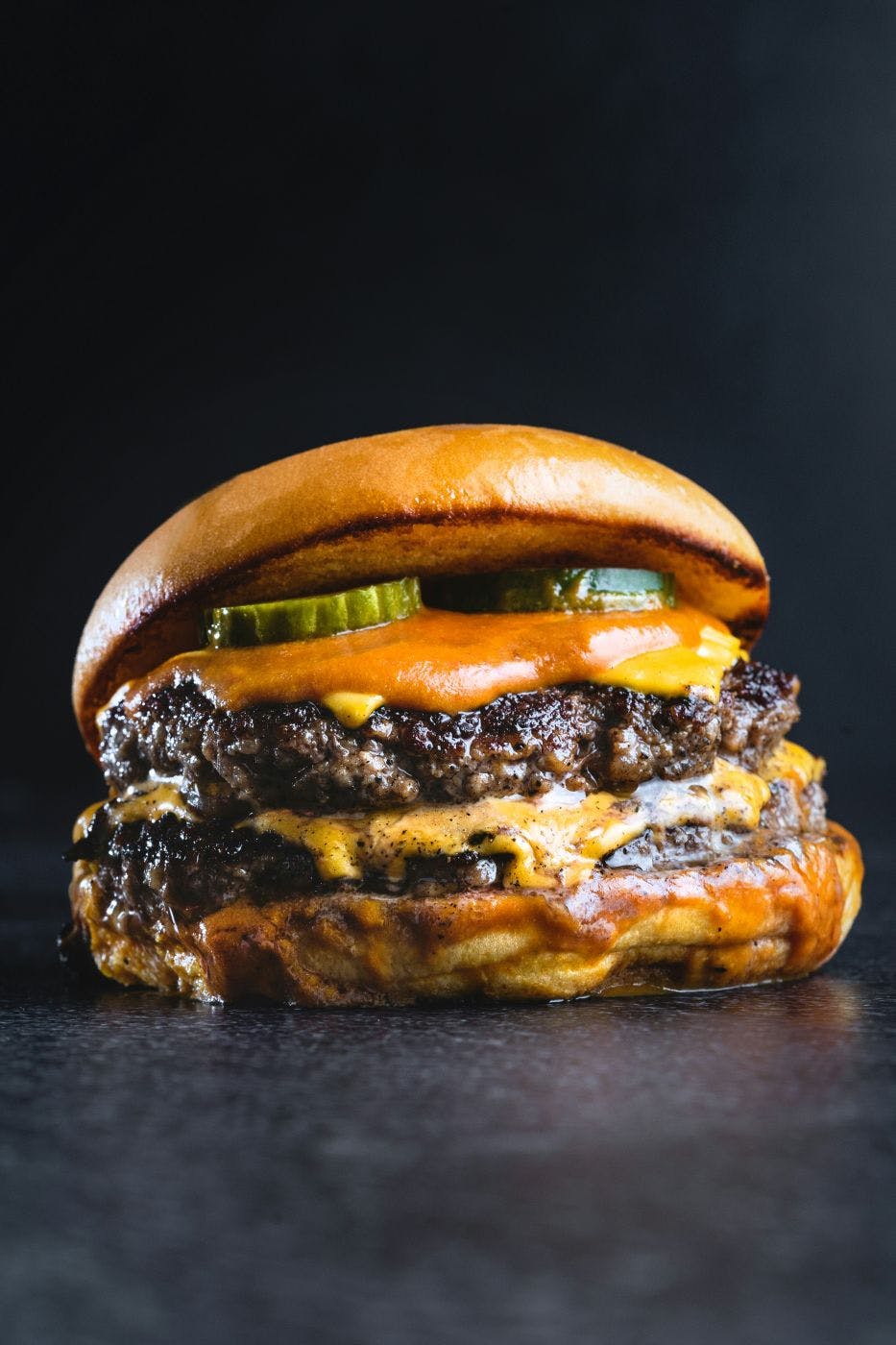
The first thing I noticed about this burger is the heft. Now, you can have your Wendy’s Dave’s triple, your Burger King’s Big King XL, and those are good burgers; however, they’re pretty lightweight compared to the Serengeti Delight. The King XL weighs in at a respectable 8.8 ounces, a Dave’s triple comes in at a precooked weight of 12 ounces, and the new Big Arch from McDonald’s tips the scales at a whopping 14 ounces. Those are some heavy burgers. With that in mind, TryABurger knew it had to come up with an impressive offering if it was going to compete with the big burger boys, and did they ever.
The Serengeti Delight weighs in at a full 17.5 pounds.
After cooking.
It’s not just the weight that sets the Serengeti Delight apart from other burger joint offerings; it’s the ingredients that have critics saying, "wow," "amazing," and "seriously, is that legal?" While the top three burger places offer all-beef patties, TryABurger is going a different route, and you get choices as well.
First off, all-beef was not a staple for this little upstart chain; it was a challenge. Okay, they said, if you’re doing all beef, we’re doing a version with all wildebeest. That’s right, 25, inch-thick patties of 100% pure wildebeest. What if you’re not into wildebeest, you may ask? Well, TryABurger has an answer for you: the Serengeti combo patty. This patty is a mix of the great beasts that roam the Serengeti. The patty combines zebra, cape buffalo, giraffe, and spotted hyena meat. All fresh, never frozen, which is quite risky when you consider where the Serengeti is. Mixed with TryABurger’s proprietary blend of herbs and spices. And none of this supermarket, plastic container of spices, either. You’ll know when you’ve hit spice in the Serengeti Delight. The spices are not ground or chopped; you get whole chunks of turmeric, cardamom pods, and dried chili peppers. You can really taste the spice for like 17 hours after you eat this puppy. On top of that, you’ll delight your molars with unground peppercorns and coarse salt.
Note: No puppies are used in the making of the Serengeti Delight. I mean, seriously, there are no puppies roaming the Serengeti.
Now, maybe you’re thinking it’s just another burger. But wait. As I said, TryABurger is all about choices. So instead of a burger patty, you can order the Serengeti Delight chunky style. Instead of the same ol’, same ol’ patty, you get chunks of all your favorite Serengeti meats. Chunks of Cape buffalo, chunks of giraffe, and, yum-yum, hot steaming chunks of spotted hyena. On top of that, you can get your Serengeti Delight either boneless or bone-in. This way, you can take the bones home and make a nice soup. The recipe for Serengeti Delight soup is available for purchase at any participating TryABurger.
The Serengeti Delight comes with onions, pickles, and mugwort, along with the signature Serengeti sauce. This sauce is a creamy combination of clay, tree bark, and termite blood. It’s zesty, surprising, and aromatic. Really aromatic. Like, don’t eat this one in the car before a date, aromatic. With all those incredible ingredients, the weight and the mystifying flavors, you’d probably think you’re going to pay as much as the $9 Big Arch. But you’d be wrong. The Serengeti burger is much more expensive, coming in at $36.82. Make it a combo with a side of Commiphora fries and a cup of warm, unprocessed wildebeest milk for only $7 more. How can you go wrong?
Now I would be remiss in this review if I just showered the Serengeti Delight with wild praise; it is good, but there are a few things you should be aware of before you trot off to your local TryABurger and get one of these grassland delights. The first thing is availability. TryABurger is fanatical about freshness, and if you’ve ever tried to get a haunch of zebra into your carry-on luggage, you’ll understand the trouble.
To ensure absolute freshness, TryABurger brings animals from the Serengeti to the US every day, and herein lies the trouble. Getting the animals passports and seats on domestic flights is a nightmare. First off, these wild creatures are not at all pleased about getting their passports, and taking pictures of them is nearly impossible. So some days a giraffe will miss a flight or get held over by weather in Atlanta, and if you think you hate the Atlanta airport, try navigating it as a giraffe. When TryABurger first wanted to offer this new culinary experience, the first herd of zebras that came over switched flights, went to Orlando, and spent a week at Disney World. The point being that, depending on flight availability and cooperation, the Serengeti Delight may not be available at times.
Second warning, if you order this new offering at the drive-thru, be prepared to wait. The burger requires a team of four to operate a cantilever-and-pulley system to get it from the restaurant to your car. TryABurger strongly suggests you have an SUV or a pickup truck if you’re going to order this burger.
Also, you should be aware that TryABurger has set up a new “Slaughter Zone” by their dumpster to ensure the freshest cuts. And hacks. And stabs and… well, you get the point. Keep the kids occupied as you go through the drive-thru, and that’ll save on trauma and therapy costs later in their lives.
And finally, if you’re one of those folks who like to know the nutritional value of what they eat, you’re in luck. TryABurger offers ingredients, calories, and all nutritional information in a book the size of War and Peace. That’s yours to keep!
For those unfamiliar with TryABurger, let me enlighten you. This is a small burger chain that I made up for the purposes of this blog. It doesn’t exist outside my mind and my bathroom mirror. There is no menu, no drive-through, no corporate offices; it’s simply a name I made up for a burger chain I used to make a point in this blog.
But the strange thing is, the logic behind the Serengeti Delight isn’t fictional at all.
So, Why Invent a 17.5 Pound Burger?
Now, you might be wondering why I went to all the trouble of inventing a 17.5-pound burger made from wildebeest and hyena. Fair question. The answer is simple. Because it is not actually that far from how brands behave in the real world.
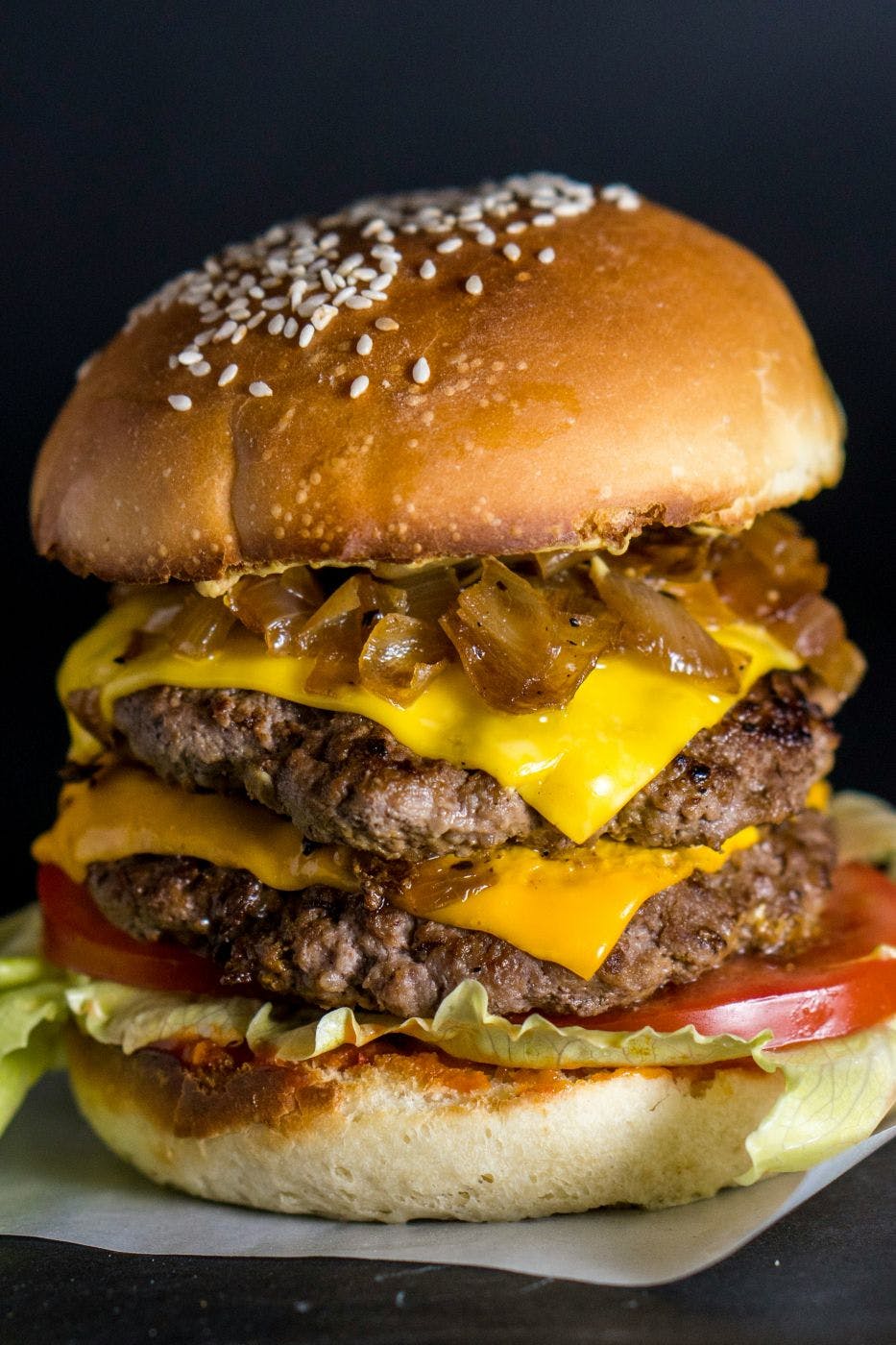
Fast-food chains have been quietly competing in what can only be described as a burger-escalation program for years. One company introduces a larger burger, and it does well. The others take careful notes. Soon they have a larger burger too. Then someone adds another patty, someone else adds more bacon, and before long, every drive-thru menu features something that sounds like it was named by a power lifter.
What makes this interesting is that the burgers themselves don’t change very much. The ingredients are almost always the same, a familiar cast of characters. Beef, cheese, lettuce, tomato, pickles, and sauce. Occasionally, someone throws an onion ring on top just to keep things lively. The real differences tend to appear in two places. The name gets bigger, and the burger gets heavier.
From a distance, the whole thing starts to look less like innovation and more like a friendly but relentless competition to see who can push the idea of a burger just a little further than the next guy.
Which is exactly how you eventually end up with something like the Serengeti Delight.
When One Brand Moves, the Others Follow
This isn’t just a fast food thing. It happens in almost every industry you can think of. One company releases something that works, and before long, the rest of the category starts circling the same idea.
A burger gets bigger, and suddenly everyone has a bigger burger. A phone adds another camera lens, and within a year, every other phone seems to have grown one too. A streaming service adds an ad-supported tier, and the rest begin studying the menu board.
Nobody holds a secret meeting where all the companies agree to copy each other. It just sort of happens. One brand finds a path that seems to be working, and the others step carefully onto the same trail. Nobody wants to be the company that ignores the thing customers suddenly seem excited about.
The result is that categories gradually begin to look more alike. The same features appear everywhere. The same promises start showing up in slightly different language. Even the product names begin to feel like cousins.
For the untrained eye, it can look like competition, but most of the time, it’s really something closer to synchronized swimming.
Companies aren’t just competing with each other. They’re also quietly watching each other, measuring what works, and adjusting their own offerings so they don’t fall behind. It feels safer to move a little faster or a little bigger inside an idea that already exists than to step outside the category and try something completely new. Which is how perfectly normal industries sometimes drift toward perfectly strange places. Like a 17.5-pound burger made from animals that absolutely did not volunteer for the job.
Why Original Ideas Make Brands Nervous
If you are wondering why companies tend to follow each other instead of inventing something completely new, the answer is not very mysterious. Original ideas make people nervous.
When a brand releases something that already exists in the market, a certain comfort is built in. The company knows customers understand the product. They know competitors have already tested the waters. They know the category has room for it because someone else is already selling it. In other words, the risk has been partially absorbed by the other guy.
Doing something genuinely new feels very different. There are no guarantees, no familiar benchmarks, and no competitor to point to if things go sideways. If the idea fails, the company cannot claim it was simply keeping up with the industry. They have to admit they tried something unusual, and it didn’t work.
So instead of wandering too far off the path, most brands make smaller moves inside the same basic idea. A slightly bigger version. A slightly faster version. A version with a few extra features sprinkled on top.
It can look like innovation, but often it is really a form of careful imitation. Each company is trying to stand out just enough to compete while staying close enough to the pack that the move feels safe. Like wildebeest. Which is why so many industries eventually end up offering products that feel strangely familiar.
Different logos. Different packaging. But underneath it all, a lot of the same ideas just wearing slightly different uniforms. And if that process keeps going long enough, someone eventually decides the best way to compete is to add another pound of meat to the burger.
How Categories Quietly Make Everything Look Alike
Once a few companies begin competing inside the same idea, something interesting starts to happen. The category itself begins to shape the rules of the game.
Customers start expecting certain things. Competitors start matching those expectations. Before long, the products across an entire industry begin to resemble each other in ways that are almost uncanny.
Walk into a handful of burger chains, and you will notice the pattern pretty quickly. There is the classic burger, the one with bacon, the one with double patties, and the one that promises to be the biggest thing you have eaten since Thanksgiving. The names change, the logos change, but the underlying idea stays remarkably consistent.
From the company’s point of view, this makes perfect sense. If a particular kind of burger is selling well down the street, ignoring it entirely would feel a little reckless. Offering your own version feels safer. Reasonable, even.
But over time, this careful logic has a side effect. The more brands compete within the same frame, the harder it becomes to imagine anything outside that frame. The question slowly shifts from “What could this product become?” to something narrower, like “How can we make our version just a little more impressive than the one next door?” And that’s when escalation begins to creep in.
At first, it is small. Another slice of cheese. An extra patty. A sauce with a slightly more dramatic name. But competition has a funny way of pushing ideas further than anyone originally planned.
Which is how perfectly ordinary products can slowly drift toward perfectly strange outcomes. Sometimes strange enough that a 17.5-pound burger made from giraffe starts to sound like a perfectly reasonable next step.
The Problem Isn’t Competition. It’s Gravity.
What’s happening in most industries is not quite copying and not quite innovation. It is something quieter than that.
Once a category settles into a familiar shape, companies begin to work inside that shape without noticing it anymore. The assumptions about what the product is supposed to be become invisible. Nobody debates them. Nobody questions them. They simply become the starting point for every new idea.
A burger is supposed to be beef, a bun, and toppings. A phone is supposed to be a slab of glass with cameras on the back. A streaming service is supposed to have a giant library and a monthly fee. These ideas become so normal that they stop feeling like decisions and start feeling like facts.
From that point on, most innovation happens within the boundaries already in place. The burger gets heavier. The phone gets faster. The streaming catalog gets bigger. Each company tries to push the idea a little further without stepping outside the shape the category has already drawn. That is where escalation comes from.
No one wakes up in the morning determined to build the most ridiculous burger ever assembled. It happens slowly. One company goes a little bigger. Another adds another layer. Someone else decides their version needs a more dramatic name.
And after years of perfectly reasonable decisions, you suddenly find yourself staring at a menu item that weighs seventeen and a half pounds and requires animals that absolutely did not belong in the scenario.
At that point, the category has drifted so far in one direction that the absurd begins to look almost logical.
Why Following Feels Safer Than Leading
There’s another reason this pattern shows up again and again, and it has less to do with strategy than with human nature.
Inside most companies, new ideas don’t simply appear on a menu board or in a product catalog. They move through rooms full of people. Someone proposes the idea. Someone else imagines how customers might react. Eventually, the discussion drifts to the question that quietly sits behind almost every new proposal. Has anyone else done this?
If the answer is yes, the conversation tends to relax. There is a reference point. A competitor has already taken the first step, which means the risk no longer feels entirely theoretical. The idea may still be debated, but it no longer feels like stepping into the dark.
If the answer is no, things become more complicated. Being first means there is no example to point to if the idea struggles. It means the team owns the outcome completely. For most organizations, that’s a heavier burden than simply improving something the market already understands.
So ideas gradually shift. They become a little safer, a little more familiar, a little closer to what the category already recognizes. Nobody sets out to copy anyone else. It just happens through a series of perfectly reasonable decisions.
Multiply that instinct across an entire industry, and the result is predictable. Products begin to resemble each other. Names start to sound alike. The differences grow smaller and smaller.
And eventually, the most noticeable way to stand out is to make the burger bigger. Much bigger. Seventeen and a half pounds bigger.
The Takeaway
The Serengeti Delight doesn’t exist. At least not yet. No restaurant is currently flying giraffes across the Atlantic or installing pulley systems at the drive-thru window. But the thinking behind it is very real.
When companies compete on the same idea for long enough, the easiest way to stand out is simply to push that idea a little further than the next guy. A bigger version. A richer version. A louder version. Something that grabs attention without wandering too far from what customers already recognize. It feels safe. It feels competitive. It even looks like innovation from a distance.
But over time, it can lead entire industries in some strange directions. The products grow more dramatic, the names grow more heroic, and the differences between brands begin to shrink until everyone is essentially selling the same thing with slightly different decorations.
That is the gravity of categories at work. Once a pattern takes hold, it quietly pulls every competitor toward the same center.
At ThoughtLab, we spend a lot of time helping companies step back from that gravity for a moment. Not to build a bigger burger, but to question the assumptions the category has stopped noticing. Sometimes, the most valuable move a brand can make is not pushing the existing idea further, but redefining the idea itself.
Which is a long way of saying this. If every competitor is building a slightly larger burger, the smartest move might not be to go with 17.5 pounds. It might be asking why it has to be a burger at all.